
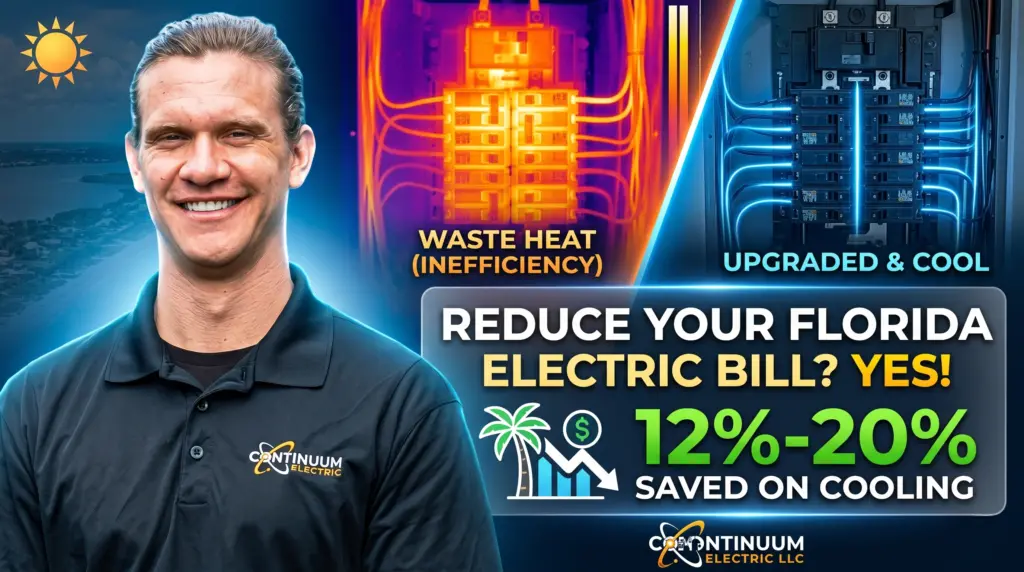
The characteristic heat of Florida’s Treasure Coast forces residential air conditioning systems to run almost continuously for most of the year. This constant use subjects residential electrical systems to high energy demands, significantly driving up monthly utility bills. However, few homeowners connect their rising electricity costs to the internal inefficiencies of aging distribution panels and obsolete wiring.
The Physics of Inefficiency: Contact Resistance and Voltage Drop
When an electrical system ages or is overloaded, contact points within the main service panel undergo progressive mechanical degradation, which is accelerated by Palm City’s high humidity and coastal salt air. This degradation increases electrical contact resistance. According to Joule’s Law, the rate of thermal energy dissipation in a conductor is directly proportional to the square of the current of the medium:

This heat generation is not only a latent fire hazard; it represents electrical energy dissipated as waste heat before ever reaching household appliances. As a direct consequence, a voltage drop occurs across the circuit. When the voltage supplied to an inductive motor (such as an AC compressor or a pool pump) decreases, the equipment is forced to draw more current to maintain its required mechanical power output. This spike in current draw increases the total kilowatt-hours recorded by the utility meter.
The ROI of Electrical Modernization
Through detailed signature inspections, Continuum Electric’s technical team can accurately measure the efficiency of a home’s distribution system. Replacing an obsolete breaker panel with a modern system optimizes electrical flow, eliminates high-resistance connections, and balances phase loads—yielding direct energy savings.
The following table outlines the financial projections and operational benefits of upgrading an inefficient electrical system in Martin County :
| Baseline Electrical Condition | Recommended Corrective Action | Estimated Energy Savings | Typical Amortization Period | Additional Safety & Compliance Benefits |
| 100-Amp panel with thermal hot spots detected via thermography. | Complete panel replacement to a 200-Amp panel with copper busbars. | 12% to 20% in cooling-related consumption. | 5 to 8 years | Eliminates voltage drops and reduces fire hazards from arc faults. |
| Main service feeders showing a phase imbalance exceeding 15%. | Physical load-balancing across phases and replacement of fatigued breakers. | 5% to 8% overall reduction in power waste. | 2 to 4 years | Minimizes mechanical wear and overheating in high-draw appliance motors. |
| Outdoor meter enclosure with signs of galvanic corrosion. | Service entrance rebuild, application of anti-oxidant joint compound, and weatherproofing. | 3% to 5% in conductivity loss prevention. | 1 to 2 years | Prevents partial blackouts and damaging voltage fluctuations. |
By optimizing the primary electrical distribution infrastructure, homeowners do not just protect their high-value electronics; they ensure that every kilowatt billed by the utility is efficiently utilized by their household systems.