
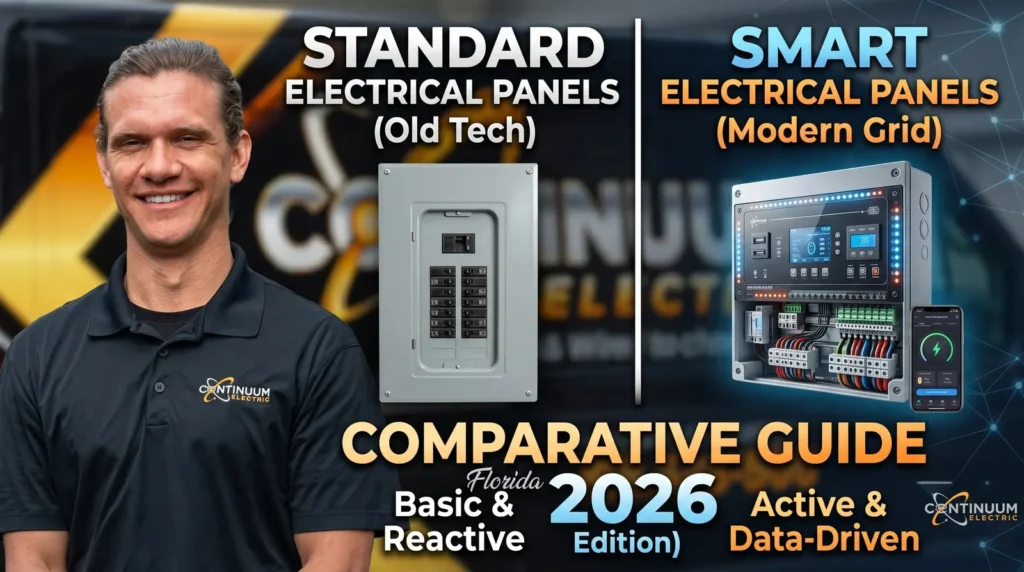
The growth in energy consumption in modern Palm City households has surpassed the design capacity of systems installed in the late 20th century. Integrating Level 2 electric vehicle (EV) charging stations, high-efficiency HVAC units, and smart home automation requires precise control over the home’s electrical capacity. Consequently, homeowners must understand the design and safety differences between available electrical distribution technologies.
NEC Load Calculations and Safety Limits
According to National Electrical Code (NEC) Article 220, a home’s total load must be calculated by summing the volt-amperes of general lighting, small appliance branch circuits, and specific heavy appliance loads, applying demand factors where allowed. For safe, continuous operation, the continuous load must not exceed 80% of the main overcurrent protection device’s rating:
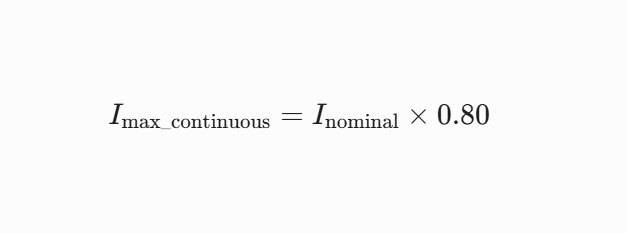
In a standard 100-amp panel, the maximum continuous safe load is only 80 amps (19.2 kW at 240V). A single Level 2 EV charger can draw up to 40 amps of continuous current, consuming 50% of the home’s total safe capacity and causing frequent main breaker trips when operating alongside other household appliances.
Evaluating Electrical Panel Technologies
To resolve capacity issues and improve safety, homeowners can choose from different tiers of electrical equipment, each suited to specific usage profiles.
| Evaluation Parameter | Legacy Standard Panels (e.g., 100A / 125A) | Modern Standard Panels (e.g., 200A) | Smart Electrical Panels (e.g., Smart Panels) |
| Amperage Capacity | Limited (100A to 125A); insufficient for modern heavy electrical loads. | High (200A to 225A); the current standard for modern residential construction. | High (200A to 225A) combined with dynamic software-based load management. |
| Consumption Monitoring | None; requires manual reading of utility meters or third-party clip-on sensors. | None; relies entirely on the monthly utility bill. | Real-time monitoring down to the individual circuit level via mobile app or web interface. |
| EV Charger Compatibility | Highly restricted; requires expensive external load shedding hardware to avoid overloading. | Fully compatible; requires physical space for a double-pole breaker on the busbar. | Smart prioritization of EV charging; automatically pauses charging if the home approaches peak demand. |
| Active Safety Features | Low; relies solely on the mechanical thermal-magnetic trip curve of individual breakers. | Medium; incorporates Arc-Fault (AFCI) and Ground-Fault (GFCI) circuit protection. | Excellent; provides predictive alerts for elevated temperature or abnormal current draws on specific circuits. |
Upgrading to a modern 200-amp panel eliminates the risk of overloads and future-proofs the home for electrification. Meanwhile, smart panels add a layer of digital intelligence that allows homeowners to schedule high-draw appliances during off-peak hours, optimizing the household operating budget.