
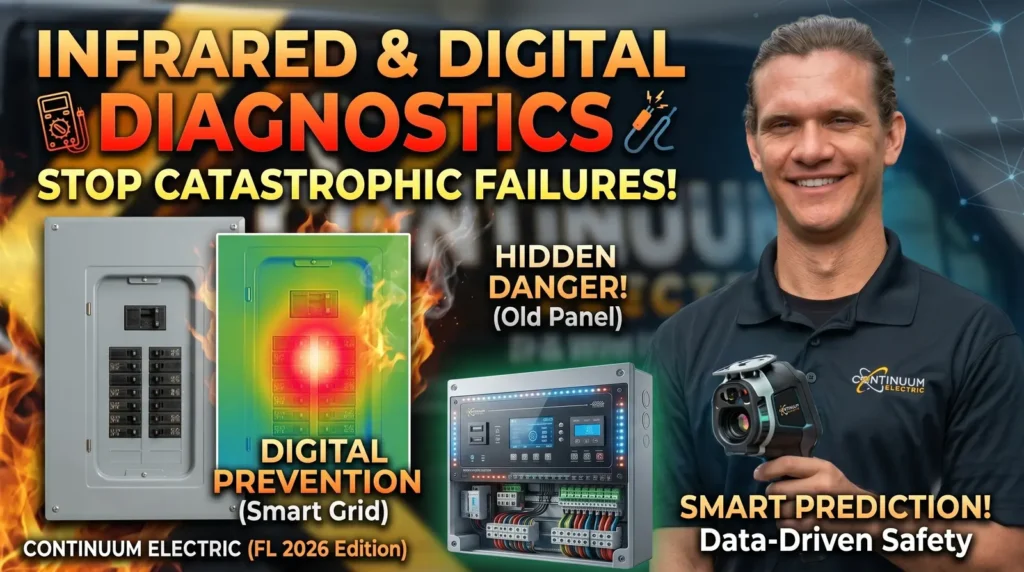
Electrical safety in a Palm City home or business depends on identifying anomalies that are completely invisible to the naked eye. Wiring faults and loose terminals do not fail suddenly; they develop progressively over time, creating localized hotspots that degrade insulation and components. Incorporating advanced diagnostic technologies represents the difference between a simple, proactive repair and a catastrophic electrical fire.
The Physics of Thermal Imaging in Electrical Systems
The infrared radiation emitted by an object is directly proportional to its absolute temperature raised to the fourth power, as described by the Stefan-Boltzmann Law:

Where $E$ represents thermal emissive power, $\sigma$ is the Stefan-Boltzmann constant, $\epsilon$ is the emissivity factor of the material, and $T$ is the temperature in Kelvin.
During signature inspections conducted by Continuum Electric, calibrated thermographic cameras are used to detect thermal differentials as small as 0.1 °C within panel boards. A breaker or termination displaying a thermal signature significantly higher than its adjacent conductors reveals high contact resistance. This is typically caused by salt-air corrosion, metal fatigue, or poor mechanical torque.
Thermal Signature in Electrical Terminals (Thermography):
[Incoming Feeder] ---> --->
                                      |
                                      v
                     (Detected by Infrared Camera)
Protecting Homes from Surge and Grid Transients
Beyond internal connection issues, homes in Martin County are constantly exposed to lightning strikes and power surges from the local utility grid. An integrated safety strategy must combine a certified low-impedance ground-ring with Type 1 and Type 2 Surge Protective Devices (SPDs).
- Certified Grounding Systems: Direct fault currents safely into the earth, preventing dangerous touch voltages on metal appliance surfaces. The installation of Ground Fault Circuit Interrupter (GFCI) outlets in kitchens, bathrooms, and garages provides essential, mandatory life-safety protection against ground faults.
- Whole-House Surge Protection: Type 1 and Type 2 SPDs absorb transient voltage spikes from lightning strikes or utility switching, preventing destructive overvoltage waves from reaching the sensitive microprocessors in modern household appliances.
Implementing precision-driven digital diagnostics and engineered physical protection safeguards your home’s operational continuity, providing peace of mind backed by scientific data.